Our (Not-So-Secret) Master Plan
Update — July 2026: Stage 1 of this plan is now delivered. ConstructAI is officially out of beta. See exactly what we shipped — full structural concrete models with rebar detailing, straight from 2D drawings — in Our Roadster Moment: ConstructAI is Live.
The 3 AM Problem
It’s 3 AM. You’re staring at a spreadsheet that doesn’t add up. The concrete pour is in six hours. You’ve triple-checked the take-off, run the numbers again, cross-referenced the drawings. But something’s wrong—you can feel it in your gut.
If you over-order, you eat the cost and watch your bid margin evaporate. If you under-order, you halt the pour, blow the schedule, and eat the penalty. Either way, you lose.
This moment—this impossible choice born from uncertainty—isn’t rare. It’s Tuesday.
For decades, you’ve been promised software that would fix this. Instead, you got tools that created more work than they solved, required you to change how you operate, and couldn’t handle what actually happens on a real jobsite. You’ve heard the pitch a hundred times: “digital transformation,” “cloud-based solutions,” “AI-powered insights.” Most of it has been, to put it generously, bullshit.
We get it. We’ve lived it. And we think there’s a better way.
The Tesla Blueprint for Legacy Industries
In 2006, Elon Musk published something called the “Secret Master Plan.” The auto industry laughed. Electric cars were golf carts. His idea—build an expensive sports car, use that money to build something more affordable, repeat until you’ve transformed transportation—seemed naive at best.
The plan worked. Not because Musk had magic technology, but because he had a logical sequence: prove the technology works with a high-margin product, build credibility and cash flow, use that foundation to scale, and ultimately change the entire paradigm of how cars get made and powered.
Construction is where the auto industry was in 2006.
A massive, essential industry—$13 trillion globally—running on processes that haven’t fundamentally changed in decades. An industry losing $1.85 trillion annually to bad data. An industry where productivity has actually declined since 2000 while costs have outpaced inflation. An industry where 88% of firms can’t fill their open positions, and the labor shortage alone costs over $10.8 billion per year.
An industry that deserves better. An industry ready for a systematic transformation.
We’re not here to sell you another piece of software that collects dust after the free trial ends. We’re here to build the intelligence layer that fundamentally rewires how buildings get made—from concept to construction.
Here’s our plan.
What We Believe
Before we tell you how, we need to tell you why.
We believe the industry’s chronic dysfunction—the endless rework, the busted budgets, the blown schedules—is not an unavoidable cost of doing business. It’s a data problem. And data problems are solvable.
We believe that data is the most valuable yet most tragically underutilized asset on any jobsite. It’s scattered across PDFs, trapped in spreadsheets, locked in someone’s head, or worse—lost entirely.
We believe that project managers and superintendents should be strategic leaders, not full-time firefighters. Your expertise is best used solving the unique challenges of a project, not chasing down paperwork or fixing data entry errors.
We challenge the status quo that accepts “over budget and behind schedule” as just how construction works. Predictability should be the standard, not the exception.
We envision a future where every jobsite is a self-correcting system. Where risks are identified before they become crises. Where your most experienced people spend their time on what they do best: building, leading, and solving problems that actually require human judgment.
Our mission is to build the intelligence layer that makes this future real.
Now, here’s how we get there.
Stage 1: We Start Where It Hurts Most
Master the Foundation — Literally
There’s a saying in construction: “You wait on the concrete, it doesn’t wait on you.”
Concrete is unforgiving. Once it’s poured, it’s permanent. A bad take-off isn’t just embarrassing—it’s financially devastating. Miss your quantities and you’re either eating wasted material or halting a pour, watching your schedule crumble while change orders pile up.
This is why we’re starting here.
Not because concrete is easy—because it’s hard. It’s one of the most complex, high-stakes workflows in construction. Master this, and we prove the technology works. Build the trust. Create the data foundation. Generate the cash flow for what comes next.
Think of this as our Roadster moment.
Tesla didn’t start with the Model 3. They started with an $89,000 sports car that could smoke a Porsche. It wasn’t the end goal—it was proof the technology worked and the revenue to fund what came next. For us, solving concrete take-offs perfectly is our proof of concept.
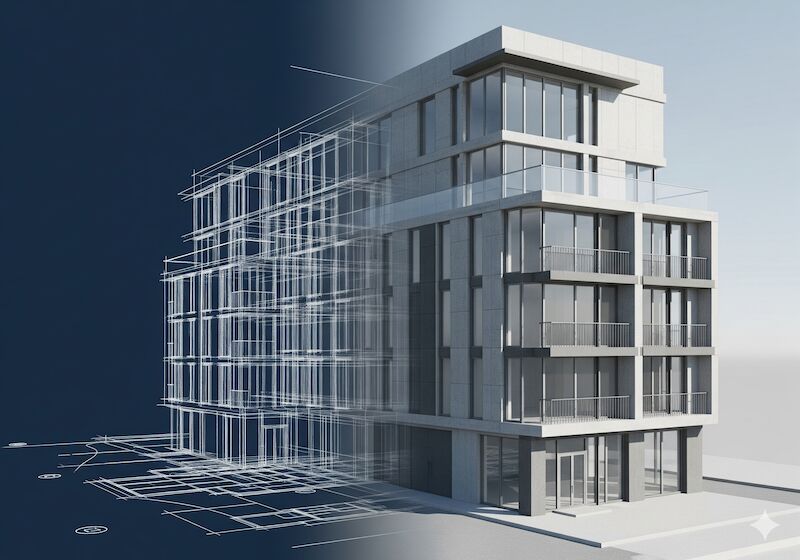
We’re building AI that converts 2D plans into intelligent 3D models and generates material take-offs with unprecedented speed and accuracy. When you see it work—when you see it catch the mistakes you would have caught at 3 AM—you’ll know this isn’t vaporware.
The message is simple: Win more bids. Waste less concrete.
But this is just the beginning.
Stage 2: We Connect the Entire Workflow
From Estimate to Execution, Seamlessly
A perfect take-off that dies in a spreadsheet is still wasted potential.
You know the pain: the estimator creates a brilliant bid, then manually types those numbers into a different system for procurement. The procurement team re-keys them into purchase orders. The PM builds a schedule based on a PDF someone emailed last Tuesday. At each handoff, data degrades. Errors multiply. The “telephone game” costs you money.
Stage 2 is about eliminating that friction.
We take the concrete take-off we’ve mastered and link it directly to costing, procurement, supplier management, and scheduling. No more manual data entry. No more version control nightmares. No more wondering if the PO matches the original estimate.
This is our Model S phase: take the proven technology and integrate it into a complete, seamless workflow for one trade. The estimator’s work flows automatically to the PM. The PM’s schedule updates when suppliers confirm delivery. Everyone works from the same single source of truth.
The message evolves: From bid to pour, intelligently.
Once we’ve nailed the complete workflow for one discipline, we scale it.
Stage 3: We Scale Across Every Trade
The Preconstruction Command Center
Concrete was the proving ground. Now we replicate that success across structural steel, MEP, framing, finishes—all the major trades.
But here’s the critical part: we’re not trying to replace Procore, Bluebeam, or the tools you already rely on.
We’re building something different. Think of it as the intelligent connective tissue—the navigation layer that brings real-time, accurate data into the systems you already use.
Here’s the best analogy we’ve found:
Your project plan is a paper map. It shows the intended route. Our platform is the Waze for your project. It monitors real-time conditions on the ground—traffic jams (supply chain delays), road closures (subcontractor issues), accidents (on-site rework)—and instantly recalculates the most efficient path forward to keep you on schedule and on budget.
This is when digital transformation actually means something. Because when done right, it’s not about doing the same things faster—that’s just a really fast caterpillar. Real transformation is the caterpillar becoming a butterfly: a fundamental change in capability.
At this stage, we become the central data repository for the entire preconstruction lifecycle. We’re capturing a massive, cross-disciplinary dataset—understanding the complex relationships between different trades, their costs, their schedules, and their dependencies.
The message matures: From accurate bids to predictable projects.
And this data—this structured, comprehensive understanding of how buildings actually get built—is the fuel for the final stage.
Stage 4: We Change the Game Entirely
From Concept to Construction in Days, Not Months
This is our Model 3 moment—when the technology becomes truly transformative.
Imagine this: An architect has a concept. Performance requirements. A budget. They feed it into our platform. Days later—not months—they have fully detailed, code-compliant construction documentation and a reliable budget. The design is optimized for constructability, cost, and schedule. Components are designed for prefabrication. The project is ready to build.
This isn’t science fiction. It’s the logical outcome of everything we’ve built in Stages 1-3.
Once we have years of data showing how buildings actually get planned, budgeted, and built across all trades, we can create a generative AI engine that compresses the entire design-to-budget cycle. This engine doesn’t just draft plans—it optimizes them based on real-world data from thousands of projects.
This is when construction becomes industrialized.
Right now, every building is a prototype. Design takes months. Value engineering happens late, compromising the architect’s vision. Prefabrication is hard because documentation isn’t designed for manufacturing.
With this platform, buildings start getting made more like Teslas: designed for manufacturing from day one, with components optimized for factory production and rapid on-site assembly. This is Design for Manufacture and Assembly (DfMA) at scale—unlocking the productivity gains that every other industry achieved decades ago.
The message becomes visionary: From concept to construction in days, not months.
This is when we stop being a software company and become the intelligence layer that powers the next generation of construction.
Why This Plan Works
This isn’t a pitch deck promise. It’s a logical sequence, battle-tested by companies that have successfully transformed legacy industries.
Each stage builds the foundation for the next:
- Master one high-stakes problem → Build credibility, cash flow, and foundational data
- Own the complete workflow for that trade → Prove integration works, expand the dataset
- Scale across all trades → Become the central intelligence layer, capture industry-wide data
- Enable a new paradigm → Use that data to fundamentally change how buildings get designed and built
We’re not asking you to believe in magic. We’re showing you a clear path from where construction is today to where it needs to be.
The Invitation
We’re starting today by solving concrete take-offs. It’s a focused, painful, high-value problem that every contractor understands.
But make no mistake: this is the first stone in a much larger foundation.
If you’ve ever lost sleep over a bad estimate…
If you’ve ever watched a brilliant superintendent spend their day buried in paperwork instead of leading…
If you’ve ever wondered why construction productivity has gone backward while every other industry has surged forward…
If you believe this industry—this essential, civilization-building industry—deserves better than the status quo…
Then let’s build it together.
This is our plan. We’re starting where it hurts most, building methodically, and aiming for a future where construction operates with the precision, predictability, and efficiency of modern manufacturing.
We’ve been on the jobsites. We’ve lived the 3 AM spreadsheet panic. We know the skepticism is earned.
But we also know this: the current path is unsustainable. The data problem is solvable. And the opportunity to fundamentally rewire how buildings get made is sitting right in front of us.
Let’s not waste it.